Thursday, October 5, 2017


Monday, October 2, 2017
Hoys seeds from the same pods grow at different speeds
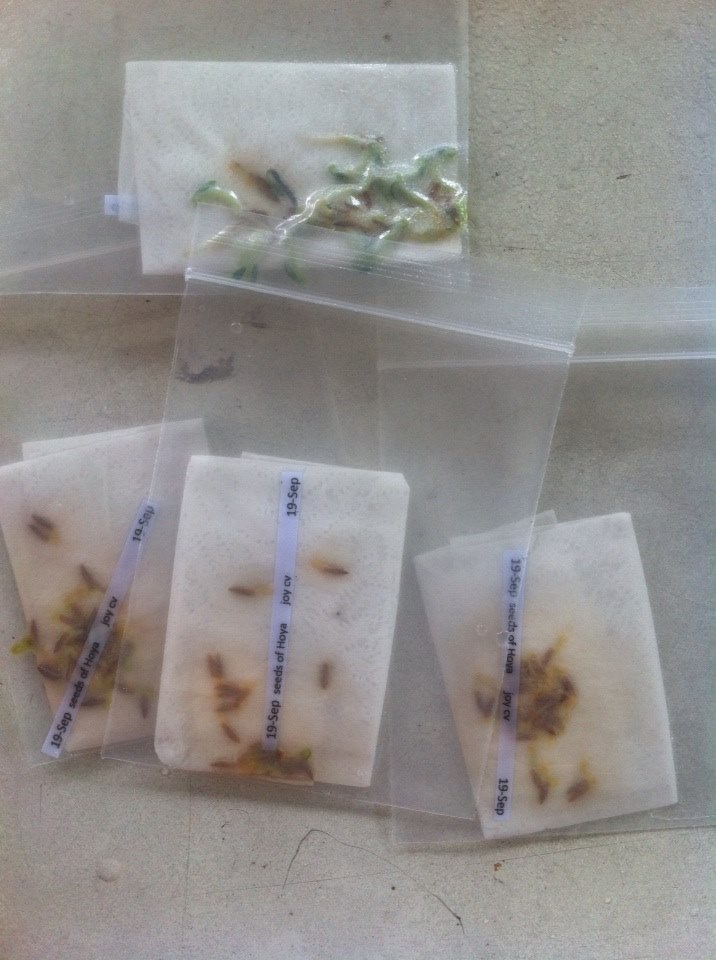
Hoya cv Joy and Hoya elliptica seeds : these 5 Hoya elliptica seeds in picture below are from
the same pod, they were packed the same day in the same conditions :
amazingly 2 of the seed lots are growing much slower than the 3 other
lots. Why is it the whole lot and not just a few seeds in the lot ??
Would seeds have a communication of some sort ??
The same questions arises with Hoya cv Joy : all the seeds in 1 of the packs are grwing much faster than all the seeds in the 3 other packs.
Seeds are available from www.aleyagarden.com
http://www.aleyagarden.com/hoya_seeds Exotic plants are available on http://www.aleyagarden.com/orders__transport_costs


Thursday, March 30, 2017
Hoya easier to cultivate and more floriferous
Hoya plants easier to cultivate and most floriferous include :
Hoya buottii

Hoya campanulata

Hoya camphorifolia

Hoya carnosa
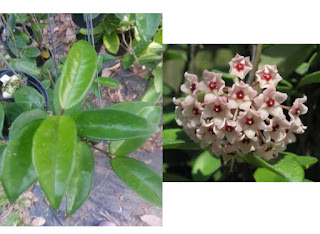
Hoya danumensis

Hoya heuschkeliana yellow flowers

Hoya multiflora philippines

Hoya mindorensis

Hoya pubicalyx

Hoya and other plant collections are for sale on aleyagarden.com Plant care is available in various posts of this blog. Contact : aleyagarden@hotmail.com
Find all Aleyagarden posts on http://aleyagarden-blog.blogspot.com
Hoya buottii

Hoya campanulata

Hoya camphorifolia

Hoya carnosa

Hoya danumensis

Hoya heuschkeliana yellow flowers

Hoya multiflora philippines

Hoya mindorensis

Hoya pubicalyx

Hoya and other plant collections are for sale on aleyagarden.com Plant care is available in various posts of this blog. Contact : aleyagarden@hotmail.com
Find all Aleyagarden posts on http://aleyagarden-blog.blogspot.com
Wednesday, August 3, 2016
The red palm weevil Rhynchophorus ferrugineus
Originally from tropical Asia, the red palm weevil Rhynchophorus ferrugineus has spread to Africa and Europe and is considered a major pest in palm plantations, including the coconut palm, date palm and oil palm.
The adult female lays approximately two hundred eggs on new growth in the crown of the palm, at the base of young leaves, or in open lesions on the plant ; the larvae, tunneling through the internal tissue of the tree for about a month can occasionally grow to a length of six to seven centimeters; they will leave the tree and form a cocoon built of dry palm fibers in leaf litter at the base of the tree. The total life cycle takes about 7–10 weeks
Hoya and other plant collections are for sale on aleyagarden.com Plant care is available in various posts of this blog. Contact : aleyagarden@hotmail.com
Find all Aleyagarden posts on http://aleyagarden-blog.blogspot.com
 |
| https://en.wikipedia.org/wiki/Rhynchophorus_ferrugineus |
 | |
| https://en.wikipedia.org/wiki/Rhynchophorus_ferrugineus |
Hoya and other plant collections are for sale on aleyagarden.com Plant care is available in various posts of this blog. Contact : aleyagarden@hotmail.com

Find all Aleyagarden posts on http://aleyagarden-blog.blogspot.com
Hoya imperialis white : limited success with planting cuts or not ?

" ... Thanks for good cooperation. Packet came safely, it was captured on the border, but everything is OK with plants. They are in good condition, the small rooted are in the best look, but I have problem with one plant... It is the second time, it comes to me in very bad condition - .. Hoya imperialis white. .. it had yellow leaves and .. completely dropped out. Only one leaf stayed with plant, but it soon got yellow and went away... "
Comment by aleyagarden
In our humid environment Imperialis is much harder to grow, perhaps even harder than praetorii, we also lose a lot of imperialis. At the moment out of 50 cuts in our nursery we are expecting to get only 2. This is why it is so expensive. We have tried everything , shade, chemicals etc the rate of survival is very low.
However a Hoya collector in Europe posted this message, saying that even without leaves she successfully plant Hoya imperialis cuts.

Hoya and other plant collections are for sale on aleyagarden.com Plant care is available in various posts of this blog. Contact : aleyagarden@hotmail.com Find all Aleyagarden posts on http://aleyagarden-blog.blogspot.com
Tuesday, December 1, 2015
Hoya mindorensis Red Star : high germination of the seeds
Hoya seed germination test : on the image each red spot is a germinating seed of Hoya mindorensis Red Star. These seeds were collected 4 days ago and packed in closed humid bags the following day ( 28 November ).


To detect the green parts and apply the red spots the image is enlarged. After this it is compressed so the quality of this picture doesn't allow detection by naked eye.
Hoya, Hoya seeds, Orchid seeds, Ferns, Fern spores and other plant collections are for sale on aleyagarden.com Plant care is available in various posts of this blog. Contact : aleyagarden@hotmail.com
Find all Aleyagarden posts on http://aleyagarden-blog.blogspot.com
Find all Aleyagarden posts on http://aleyagarden-blog.blogspot.com
Monday, October 19, 2015
Seeds of Hoya meredithii
Most Hoya varieties always produce seeds with high germination rates if planted soon after collect, ( we plant them in germinating bags ) others produce only non fertile seeds.
The test at this link shows how fertility is affected by the length of time between collect and planting :
http://aleyagarden-hoya.blogspot.com/2012/10/hoya-seeds-germination-test.html
Also some pods seem to give more viable seeds than other pods on the same plant.
But Hoya seeds can also be viable and dormant, their dormancy can last several months.
The germination rate of Hoya meredithii seeds ( in picture below ) can be very low : from a pod of selected meredithii seeds ( the flat seeds were discarded ) only one germinated in about 40

The followings Hoya seeds seem to have low or no germination :
carnosa red
pahang
vitellina
plicata
sweet scent
longifolia long leaf
leucardenasiana
mindorensis pink
parasitica
parasitika x pachiclada
estrella waterfall
mindo purple star
vitellina
tsangii
sp 7 35
globulifera
pubicalyx red button
Hoya and other plant collections are for sale on aleyagarden.com Plant care is available in various posts of this blog. Contact : aleyagarden@hotmail.com
Monday, August 10, 2015
Seeds of Hoya kerrii and Hoya juannguoiana under glass
We have started the project of a mini gardening today : we have taken seeds of Hoya kerrii and Hoya juannguoiana out from closed humid bags where they were germinating to transfer them onto soft paper at the bottom of glass bottles, then we closed the tops.

These seeds below are the Hoya kerrii

Hoya juannguoiana seeds under glass.

Hoya kerrii and Hoya juannguoiana

Hoya and other plant collections are for sale on aleyagarden.com Plant care is available in various posts of this blog. Contact : aleyagarden@hotmail.com
Thursday, July 16, 2015
Mites species belonging to two common genera (Tenuipalpus and Brevipalpus) are known to attack economic plants and cause significant damages.
Tenuipalpidae, also called "flat mites" or "false spider mites", are closely related to the Tetranychidae. They are reddish, slow moving, and normally feed near the midrib or veins on the underside of leaves. Tenuipalpus pacificus attacks orchids.
Brevipalpus obovatus and Brevipalpus phoenicis attack over 50 genera of ornamental plants.
In the two pictures below are mites of the Tenuipalpus genus
 |
| Mite of the Tenuipalpus genus |

 |
| Mite of the Tenuipalpus genus |

 |
| Brevipalpus phoenicis |
The flat mite Brevipalpus phoenicis ( on the left ) has become established in numerous southern states of the USA, throughout the mainland from Florida to California, and also in Hawaii.
More on the Brevipalpus phoenicis in Wikiedia https://en.wikipedia.org/wiki/Brevipalpus_phoenicis#/media/File:Flat_mite,_Brevipalpus_phoenicis.jpg

More on the mites of Southeast Asia
http://pikul.lib.ku.ac.th/…/016%20Allies%20and%20Ins…/Mites/
Hoya and other plant collections are for sale on aleyagarden.com. Plant care information is available in various posts of this blog :
http://aleyagarden-blog.blogspot.com/2011/02/aleyagarden-blogs.html
Contact : aleyagarden@hotmail.com
Hoya and other plant collections are for sale on aleyagarden.com. Plant care information is available in various posts of this blog :
http://aleyagarden-blog.blogspot.com/2011/02/aleyagarden-blogs.html
Contact : aleyagarden@hotmail.com
Wednesday, July 1, 2015
A 100% survival when outside humidity was 30 % : inside humidity was maintained at 85% in the grow room
Aleyagarden has sent in June to the USA many Hoya non rooted cuttings by EMS parcels to a buyer who received them fast because he had an import permit ( not mandatory for only 12 plants ) . Despite relative humidity in June from 25 to 35 % in his town , he was 100 % successful ( a 100% survival rate ) mainly because he is using a grow room for rooting at around 26 Celsius and 85% humidity :
" I just wanted to let you know that my last two Hoya shipments, including replacements, got here without incident ( Aleyagarden note : replacements were a few cuttings sent at 50% of their price in the second parcel ) . The Hoyas that didn't travel too well the first time around did not travel well the second time around either, but the survival rate will be 100% nonetheless. For whatever reason, Ischnopus had the roughest time. The second time around it arrived with no leaves, but what I was able to keep going has rooted well and is sending out leaves and vines on two partial cuttings. Overall, many of the cuttings I received have started producing leaves and vines in a little over a month. I've been running my grow room at 80 degrees and 85% humidity during the day and some things are growing like weeds. The fastest being Graveolens, UT-001 and Austrailis White Margins. Megalaster lost many leaves but even the bare vines started rooting in 4-5 days. So I'd say that my orders were successful. "
See why a humidity deficit of 20 % impacts plants much more at 35 Celsius than at 20 Celsius
See how much humidity is in your location
Hoya and other plant collections are for sale on aleyagarden.com Plant care is available in various posts of this blog. Contact : aleyagarden@hotmail.com
Thursday, June 18, 2015
A relative humidity deficit of 20% impacts plants at 35 Celsius much more than at 20 Celsius

Plants that acclimatize need around them a space of which 80 % is filled with water vapour ( humidity ). If the hygrometer indicated only 60 % there would be then a shortage of 20% ( 80% - 60% = 20 % ). How many grams of water vapour is this shortage of 20 %, hence how fast and by which means it can be filled depends on the temperature. Plant growers should always consider the % of humidity with the room temperature, not the % of humidity only.
At 20 C about 60% of humidity translates 11 gm of water vapor per cubic meter of air.
In order to target our 80 % at this temperature ( a necessary % during the rooting or the acclimatization phase of tropical plants stressed by international travel ) the water vapor must increase up to 14 gm per cubic meter, which is the amount of 80 % water vapour when temperature is 20 C.
 |
| Photo credit: University of Missouri Cooperative Media Group |

Hygrometer and thermometer are essential during the rooting or acclimatization period until the plants are released to a dryer environment. The subjective perception of heat , the " heat index " is not reliable for an " intuitive measure " of the heat and humidity levels in the greenhouse.
Why are Geneva and Stockholm better places than Madrid or Las Vegas considering the effect of the relative humidity - temperature relationship on tropical plants ?
Hoya and other plant collections are for sale on aleyagarden.com Plant care is available in various posts of this blog. Contact : aleyagarden@hotmail.com Find all Aleyagarden posts on http://aleyagarden-blog.blogspot.com
Relative humidty calculation, small chambers and commercial greenhouses.
Here tropical plant growers will find an interesting calculator of humidity.
http://hyperphysics.phy-astr.gsu.edu/hbase/kinetic/relhum.html#c4
At 20 Celsius, 1 cubic meter of air would need 17.25 gm of water vapor to saturate ( "saturate" translates : a 100% humidity, the maximum water vapour that the air can hold )
If the hygrometer of the greenhouse indicates 80% of relative humidity at this temperature the actual quantity of water vapor is about 14 gm per cubic meter.
 |
| Tropical greenhouse built in 1880, Parc de la tete d' or Lyon |
When the fogging system of the greenhouse is set to maintain 80% of relative humidity , in order to do its job at 35 Celsius it must multiply by 2.28 ( that 's a lot ! ) the quantity of water vapour at 20 Celsius : 14 x 2.28 = approx. 32 gm of water vapour.
When tropical plants acclimatize in a home in New York, Paris, Moscow or Cape Town, restart or root under a plastic chamber before being progressively released to the temperate climates, foggers may not be indispensable : the volume of the air in the plastic chamber is usually small as the plastic is close to the plants, there is a lot of plant material containing water for this volume of air and the water is put in a large plate ( the larger the plate the larger the evaporation ). Also the rise in heat is better controlled in a house than it is outside.
The simple plastic bag - chamber apparatus works well in homes but for greenhouses set outside only foggers coupled with humidity sensors can maintain smoothly the high level of humidity required to acclimatize tropical plants a few weeks, because : 1) the volume of air in relation to the quantity of plants is much higher and 2 ) from June to August heat can rise and fall high and fast ( December to February in southern hemisphere ).
The calculator of Humidity above can help evaluate in terms of gm of water vapor per cubic metre of air the gaps in Humidity percentages : one can see what a 20% humidity deficit means at 20 C and at 35 C .
Hygrometer and thermometer give an essential information that cannot be replaced with the subjective perception of heat : the heat index
Hoya and other plant collections are for sale on aleyagarden.com Plant care is available in various posts of this blog. Contact : aleyagarden@hotmail.com
Find all Aleyagarden posts on http://aleyagarden-blog.blogspot.com
Friday, May 15, 2015
Hoya patella seeds germinate 52 days after collect
" Hi Aleya, I have great news: at least 3 seeds of patella are sprouting!!
I probably planted it 35 days or more after you sent me. "

 This is very interesting, this message is not unique we have been confirmed a few times already that the Hoya seeds sprouted several weeks after harvest, also sometimes after planting, although early planting is in general more successful according to our own experiments;
below are the patella seeds packed : harvested on 23 mars, packed and shipped on 25 mars. Some Hoya patella seeds dry and others in the humid bag.
The letter was received around 15 May - yes they have a very slow postal system !
Some of the dry patella seeds just sprouted and those in the bag did not make it after so many days : 52 !!!

I probably planted it 35 days or more after you sent me. "


below are the patella seeds packed : harvested on 23 mars, packed and shipped on 25 mars. Some Hoya patella seeds dry and others in the humid bag.
The letter was received around 15 May - yes they have a very slow postal system !
Some of the dry patella seeds just sprouted and those in the bag did not make it after so many days : 52 !!!

Hoya, Hoya seeds and other plant collections are for sale on aleyagarden.com Plant care is available in various posts of this blog. Contact : aleyagarden@hotmail.com
Find all Aleyagarden posts on http://aleyagarden-blog.blogspot.com
Find all Aleyagarden posts on http://aleyagarden-blog.blogspot.com
Friday, April 10, 2015
100 % of Hoya AL5 seeds germinate , planted 3 days after harvest enclosed in humid toilet paper.

 3 days after collect the Hoya AL5 seeds are put between layers of humid toilet paper and 100 % germinate.
Hoya, Hoya seeds, Orchid seeds, Ferns, Fern spores and other plant collections are for sale on aleyagarden.com Plant care is available in various posts of this blog. Contact : aleyagarden@hotmail.com
Find all Aleyagarden posts on http://aleyagarden-blog.blogspot.com
Tuesday, October 28, 2014
41 days in a parcel returned from Europe, 4 cuts damaged in 37
The plants have been staying 41 days in a parcel to Europe. A phytosanitary certificate replacing the one sent with the parcel was lost and the parcel was returned to Thailand.
In 37 cuttings with tips in moss only 4 have been damaged. The travel was from September to end of October. September, October and November are colder and good months for shipping plants ... if they don't freeze.
Freezing may happen if the parcels stay outside too long before loading. But freezing is not an issue in modern aircraft.
 Hoya and other plant collections are for sale on aleyagarden.com Plant care is available in various posts of this blog. Contact : aleyagarden@hotmail.com
Find all Aleyagarden posts on http://aleyagarden-blog.blogspot.com
In 37 cuttings with tips in moss only 4 have been damaged. The travel was from September to end of October. September, October and November are colder and good months for shipping plants ... if they don't freeze.
Freezing may happen if the parcels stay outside too long before loading. But freezing is not an issue in modern aircraft.
Find all Aleyagarden posts on http://aleyagarden-blog.blogspot.com
Friday, August 1, 2014
Hoya imperialis Pink and Hoya imperialis Red, how do leaves differ ?
It is not easy to identify the leaves of Hoya imperialis red and pink, but when the plants are several years old the differences are more contrasted : the leaves on imperialis red are narrower, longer and slightly less undulate than on pink imperialis.
With Hoya imperials length and width are better indicators than the undulation : some individuals can be almost equally undulated.


Herbs and Spices, Hoya, Hoya seeds, Orchid seeds, Ferns, Fern spores are for sale on aleyagarden.com Plant care is available in various posts of this blog. Contact : aleyagarden@hotmail.com

With Hoya imperials length and width are better indicators than the undulation : some individuals can be almost equally undulated.
Herbs and Spices, Hoya, Hoya seeds, Orchid seeds, Ferns, Fern spores are for sale on aleyagarden.com Plant care is available in various posts of this blog. Contact : aleyagarden@hotmail.com


Monday, May 5, 2014
Broken seeds in the envelope
Hoya seeds are rare and they have a short viability; they can germinate in the envelope in transit : the growing embryo disrupts the coat and the seed seems it was broken by pressure from the outside of the envelope.


Thursday, May 30, 2013
My plants were rotten with bad smell on arrival : the bag was over watered when you packed, they rotted.
No : because we don't water the plants before packing, we let them evaporate instead, and no because rotting, dissolving as does a dry and clean cucumber inside a clean plastic bag doesn't mean the cucumber was ... "overwatered." The roots of the plants in the plastic bag rotted without the help of an excessive amount of water. ( the plastic bag was there mainly to avoid dehydration : uprooted plants use energy from the leaves and release water and heat to carry out a survival program that includes saving their roots ).
Plant decay is characterized by decomposition and putrefaction ( bad smell ) caused by any of hundreds of species of bacteria and fungi. The decay may be hard, dry, spongy, watery, mushy, or slimy and may affect any plant part.
The excessive moisture of a plant in watery decay does not indicate that its rootball was over watered when it was packed : a decomposed plant will have released its water content, which is a lot of water, in general 95% of a plant is water. So this water from the plant itself plus water evaporated from around the rootball ( coconut or sphagnum moss ) , mixed and they give now you the  impression that packing was over watered, faulty.
Cells have a membrane, and in the case of plants also a cell wall, which hold back the water and the other contents of the cell, such as salts, proteins, metabolites/sugar, and nucleic acids. When individual cells die, they dissolve ( biologists say the "lyze" or "undergo lysis") and their content are no longer held back, but begin to freely float between the surrounding cells. The more cells die, the more cell contents will be set free. This "water" is rich in nutrients, and bacteria/fungi just love it and will thrive in it. This causes the bad smell.  impression that packing was over watered, faulty.
If you want to reproduce it, take a cucumber, wrap it in a tight plastic bag, and let nature go its way. After a week or two, the cucumber will be almost dissolved, setting free all of its water, and will rot and stink. That's what happens to all plant material when it dies in a humid environment (such as a plastic bag). The roots did just that. The tissue started to die, and it reached you before it completely dissolved into a blackish stinky mush.
Nevertheless, when you squeeze it, lot of cell water will already come out of the root ball - and it will have a bad smell because of the bacteria. The root tissue also will start to have a different texture - from being crisp and elastic it will turn to sponge-like, soft and compressible. If this happens, the plant will no longer be able to survive with these roots. Parts of the stem and the leaves might still be ok (especially if only the root balls had been in a plastic bag, but the leaves exposed outside) and come back after re-rooting.
The good thing is that healthy plant parts are quite tough against the bacteria in the rotten parts (these bacteria are part of the normal environment of the plant anyway), meaning the rot usually is not contagious. So, cutting the dead parts away in a generous way (cutting well into the healthy part, that is) will "rescue" the healthy part. Whether it can root again, however, depends a lot on the species.
Some plants (mint, for example, or willow) regrow roots within a week, others will just never do it and die. Fortunately for us, Hoyas are plants that are more on the "mint" side, and most Hoya species re-root quite easily.
Hoya and other plant collections are for sale on aleyagarden.com Plant care is available in various posts of this blog. Contact : aleyagarden@hotmail.com
Find all Aleyagarden posts on http://aleyagarden-blog.blogspot.com
Monday, May 6, 2013
Ultra fast delivery in Switzerland
.... it`s amazing!!! this morning, around 09:00 o`clock, arrives my hoyapost!!!
all in best condition and soooo big!!! now i forget all all-around me and i getting to pot in the plant! and find places...if is possible...hahaha!! again very very 1000s of thank you very much!! ....
A very nice message that everyone here at aleyagarden appreciates ( like all messages received so far by the way ...)
Comment by aleyagarden : this quick parcel ( EMS ) to a city in Switzerland was posted on Tuesday 10 May at 16 : 26 Swiss time and was delivered on Thursday 12 May at around 9 : 00.
So it clearly took less than 24 hours for the parcel to arrive at the post office and be ready for the morning delivery ! Postal parcel travel on the next passenger flight, whatever the day of the week, they don't wait for the departure of non daily cargo planes and may be delivered surprisingly fast sometimes !
Hoya and other plant collections are for sale on aleyagarden.com Plant care is available in various posts of this blog. Contact : aleyagarden@hotmail.com
Find all Aleyagarden posts on http://aleyagarden-blog.blogspot.com
Tuesday, April 23, 2013
Hoya lacunosa seedlings that look different
 |
| Left : Hoya lacunosa grown from cut, right : a seedling of the species. |
If we had not know the seed was from a lacunosa possibly we might not have identified it as a lacunosa ! Indeed two Hoya lacunosa grown from cuts taken on the parent of the left one would never show such surprising differences. Growing Hoya from seeds is a good way to increase biodiversity !
 Hoya seedlings bring so many unexpected results ! in this picture on the left we got two Hoya lacunosa seedlings : none of the two has the small sized leaves of the lacunosa grown from cut above, and the seedling on the left has distinctly rounder and larger leaves. They are approximately the same age.
Hoya, Hoya seeds, Orchid seeds, Ferns, Fern spores and other plant collections are for sale on aleyagarden.com
Plant care is available in various posts of this blog. Contact : aleyagarden@hotmail.com
Find all Aleyagarden posts on http://aleyagarden-blog.blogspot.com

.
Subscribe to:
Posts (Atom)